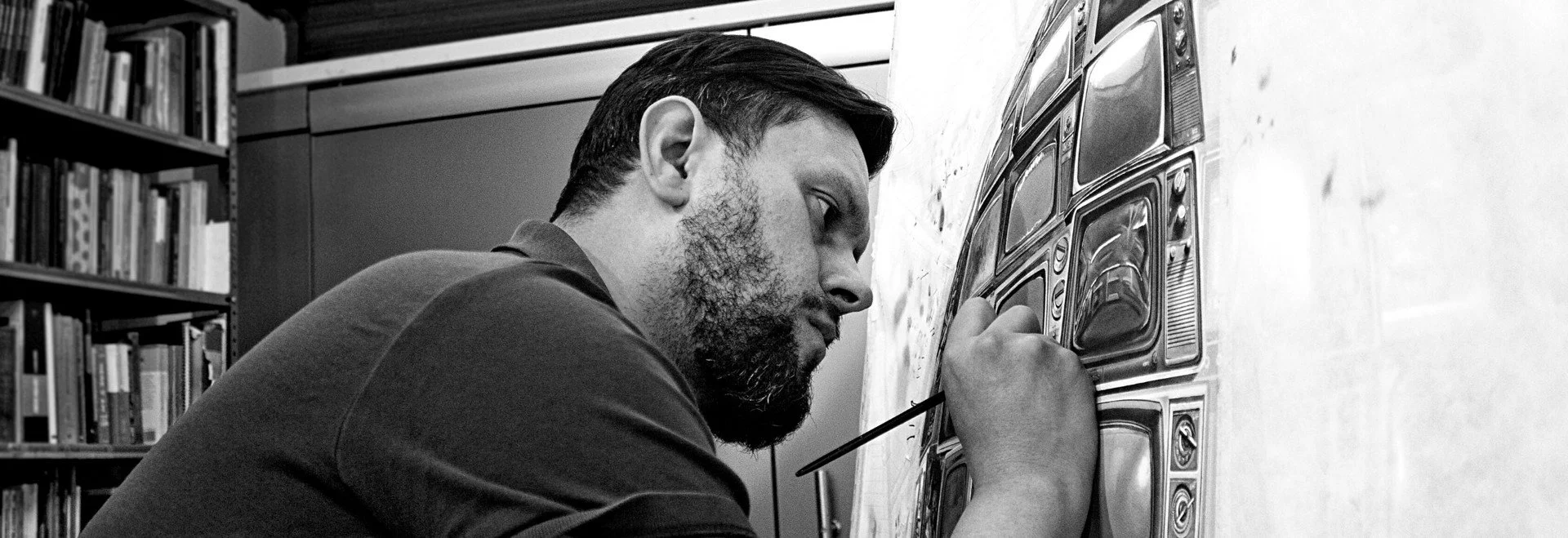
“I think of my work as a technocultural landscape: a space where machines, images, memories, and human behavior continually shape one another.”
-
As a child, I spent many hours in my father’s mechanical workshop, surrounded by machines, tools, spare parts, and exposed mechanisms. There I learned to look at objects by attending both to what they show on the outside and to the systems operating within them. I also learned that a machine can be dismantled, repaired, lose its function, or acquire another. That way of looking remains at the heart of my practice.
My work often begins as a whisper: an intuition, an image, an object, or a material whose meaning is not yet fully defined. Through time, study, and the repetition of a gesture, that murmur begins to take shape. In this process, craft becomes a way of thinking: working slowly on an image allows me to pause before what seemed familiar and discover other ways of understanding it.
For more than twenty years, watercolor has been one of my principal media. I am interested in its tension between precision and uncertainty: I can guide the pigment, but the water always retains a degree of autonomy. Its slowness and layered construction also create friction with the speed at which contemporary images circulate.
My work explores what I have begun to understand as a technocultural landscape: a territory in which technology, memory, perception, and identity are deeply intertwined. I am particularly interested in objects that once organized our everyday lives—televisions, radios, clocks, sewing machines, screens, and other domestic devices. As they become obsolete, these objects accumulate time: they retain images, gestures, desires, habits, and forms of relationship that outlive their original function.
In Panopticopías, for example, the television becomes object, frame, and landscape simultaneously. Its screens contain scenes in which memory, visual culture, and technology overlap, making visible the ways in which media images participate in our perception of the world. In Hilo Vano, old sewing machines are transformed into mechanisms that produce movement, light, or sound; their productive function is displaced, giving rise to other ways of measuring, representing, or making time, labor, the body, and memory perceptible.
These transformations allow me to observe a relationship that runs through my practice: we construct technologies and, at the same time, those technologies participate in constructing us. They organize our attention and our experience of time; we, in turn, fill them with uses, affections, images, and histories.
Perhaps that is why I continue to think of my work as a whisper. I am interested in listening to what remains in objects and images after their original function has shifted, and in finding a new form for those traces. History whispers from behind; the work consists in allowing that murmur to pass through the present and find a voice.
-
Gonzalo García Gaitán is a Colombian visual artist born in Bogotá in 1981. Working across watercolor, drawing, printmaking, installation, sculpture, animation, sound, and electronic media, his practice explores the relationships between technology, memory, perception, and material culture. He holds a BFA in Fine Arts from Universidad de los Andes in Bogotá.
For more than two decades, García has examined how technological objects and obsolete media continue to shape individual and collective experience. Televisions, sewing machines, boomboxes, domestic artifacts, and archival materials recur throughout his work, moving between meticulous representation and the construction of kinetic, sonic, and electronic installations.
His work has been presented in solo and group exhibitions in Colombia and internationally, including the 16th Curitiba Biennial (2026), Gallery Poulsen’s Nostalgia — German Tellez Invitational (2026), the Asunción Biennial, Museu Paranaense, Museo Nacional de Colombia, Museo de Arte del Tolima, CK Contemporary, Durden and Ray, SCOPE Art Fair, SP–Arte, LA Art Show, and San Francisco Art Fair.
García received First Prize at the Salón de Arte Cinético of Universidad Pontificia Bolivariana in 2024, Second Place at the Salón Nacional de Pintura in 2022, and First Prize at the III Salón de Arte Joven at Club El Nogal.